- Under ten years
- IVA test
- Ten and over
- MOT
- Over forty
- No MOT, if unchanged
- Test centre
- Our own, on site
The word test makes people nervous. It suggests the car might fail, that there will be a bill nobody mentioned, and that it might sit somewhere for weeks.
Let’s shrink that worry. For a Hong Kong car, the test is a known, predictable step. Which test depends almost entirely on the car’s age, and the work needed to pass is usually small. This guide explains which test applies, what is looked at, and how we get the car ready.
Age decides the test
There are three bands. Use the age checker on this page if you want to see where your car sits.
| Car’s age | What it needs |
|---|---|
| Under ten years old | IVA test |
| Ten years old and over | MOT |
| Over forty years old | No MOT, if not substantially changed |
It means a three-year-old Hong Kong car and a fifteen-year-old one follow slightly different routes, even though the rest of the import is the same. Everything else, the shipping, customs and registration, carries on as normal.
What the IVA test is
IVA stands for Individual Vehicle Approval. It exists because a car built for another market has not been through the UK type approval process that a car sold new here would have. The IVA test checks that the individual car meets UK standards for safety and the environment before it can be registered.
It is not a test of whether the car is a good one. It is a check that the car is built and equipped to UK requirements.
What is checked, broadly
The examiner works from the DVSA’s IVA inspection manual for passenger cars, which is long and detailed. Its sections include:
- lights and signalling, with the rear fog lamp a section of its own
- the speedometer, which must be able to show the speed in miles per hour (a digital one is fine)
- brakes
- exterior projections, such as sharp edges on the bodywork
- seats, seat belts and their anchorages
- noise and emissions
- tyres, safety glass, mirrors and the driver’s forward vision
- door latches, the horn, and the wash, wipe and demist systems
The car also has to be identifiable. The examiner can refuse to test a car whose vehicle identification number is missing or does not match it.
The manual is updated from time to time, so we prepare every car to the current version rather than a fixed checklist.
Why Hong Kong cars are a good start
Hong Kong drives on the left, so its cars are right-hand drive and built for the same traffic as ours. Hong Kong cars are also no longer scrutinised for headlight compliance. That removes the biggest jobs that cars from other markets need.
In practice, the typical work on a Hong Kong car is:
- converting the speedometer from km/h to mph
- installing or converting a rear fog light
That’s why we can usually tell you, before the car has even been collected, what it is likely to need.
Our own test lane
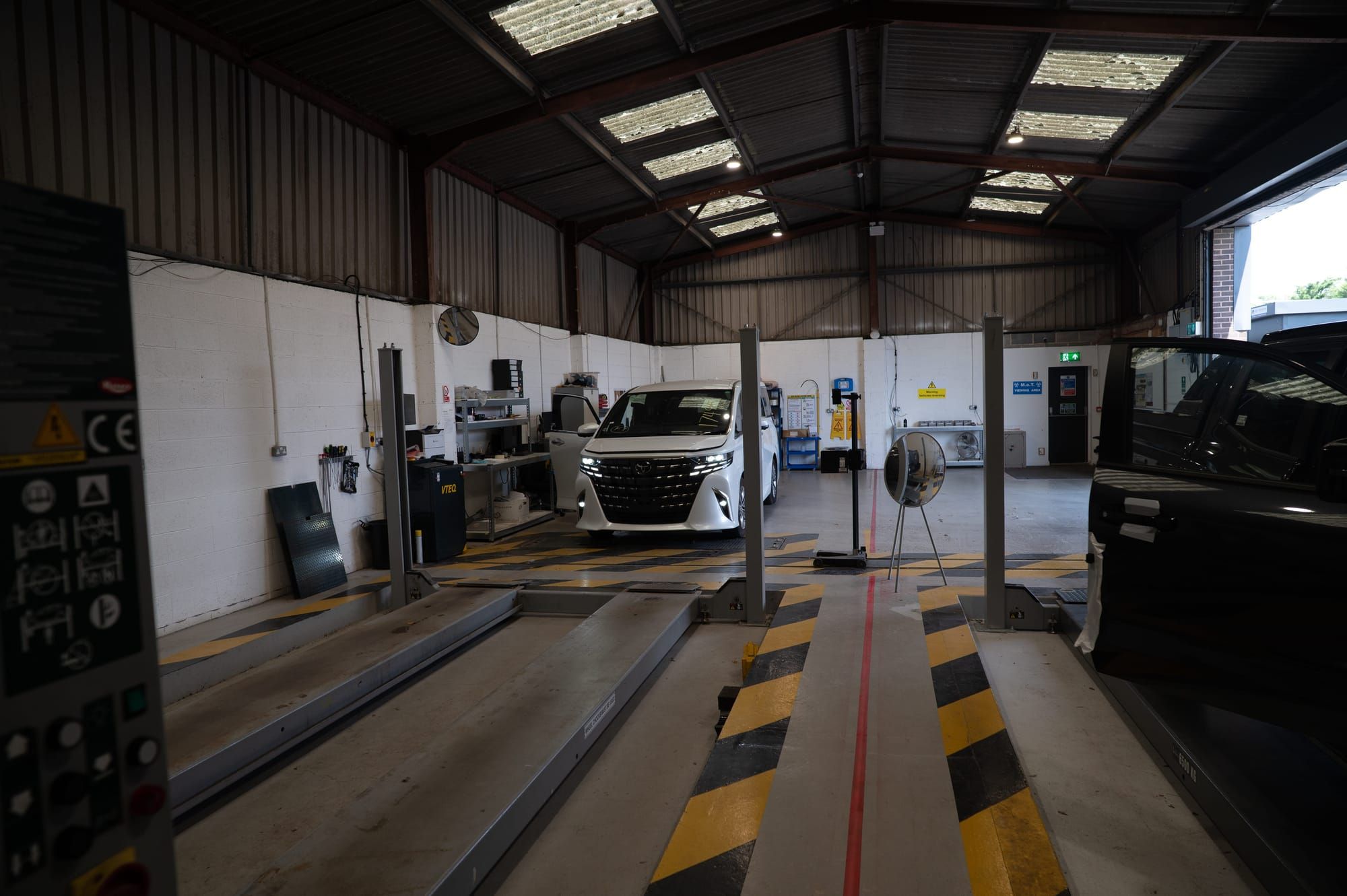
This is where we differ from most importers. We run the first privately owned IVA testing centre for passenger vehicles in the UK, at our site in Castle Donington, Derbyshire.
For you, that means a few practical things. There is no waiting for a slot at an outside test centre. Light conversions and test preparation happen in our own workshop, on the same site as the test. If anything needs attention, it is put right in the same workshop, so the car is not shuttled between sites.
The car stays in one place from the moment we unload the container to the moment it is registered. You can follow each stage in the customer portal.
It also means the people preparing your car know exactly what the test will look at, because they work alongside it every day. Test prep is not guesswork sent off to another site and hoped for. It is done, checked and tested under one roof, which is the simplest way we know to keep a car moving.
Older cars: MOT or no test
Not every Hong Kong car is a recent one. Older cars follow a slightly different, and usually lighter, route.
Ten years old and over
Cars ten years old and over do not take an IVA test. They need a valid MOT instead, which checks the car’s roadworthiness: brakes, steering, suspension, lights, tyres, emissions and so on.
The speedometer still needs to read in mph and the rear fog light still needs to be right, so the light conversions are much the same. We prepare the car and arrange the MOT as part of the job. If the MOT picks up wear and tear, such as tyres or brake parts that are near the end of their life, we will tell you and put it right in our workshop.
Over forty
Cars over forty years old do not need an MOT, as long as they have not been substantially changed. GOV.UK’s examples of a substantial change are replacing the chassis, body, axles or engine to change the way the car works. The owner must still keep the car roadworthy, and it does not skip all checks; the car still has to be registered properly, and older cars usually need evidence of their age for the DVLA. Our guide to classic cars from Hong Kong goes into that, along with the reduced tax for cars over thirty years old.
After the test
A pass is the point where the import starts to feel finished. Once the car has passed, we register it through our dealer-level DVLA account. That typically takes around 10 working days. The car then gets its UK registration number, plates go on, and we deliver it to you in an open or enclosed transporter, or store it until you are ready.
Next steps
If you want to know which test your car will need and what work to expect, Get a quote with the make, model and year. We will tell you plainly. We’d be more than happy to help should you need it.
Questions
People also ask
Does every imported car need an IVA test?
No. Cars under ten years old take an IVA test. Cars ten years old and over need an MOT instead, and cars over forty do not need an MOT, as long as they have not been substantially changed.
Where is the IVA test carried out?
At our site in Castle Donington, Derbyshire. We run the first privately owned IVA testing centre for passenger vehicles in the UK.
What happens if the car fails?
We put right whatever was picked up in our own workshop and book the retest. Because preparation, testing and fixes are all on one site, a fail is a short delay rather than a long one.
Do Hong Kong cars need much work to pass?
Usually not. They are already right-hand drive and are no longer scrutinised for headlights, so the typical jobs are converting the speedometer to mph and fitting or converting a rear fog light.